Showing posts with label Historical. Show all posts

12 December 2025

THE LAST TYCOON (1976, Elia Kazan)


* * 

The day-to-day challenges faced by a movie producer. Not as interesting as that sounds.

Starring  Robert De Niro, Tony Curtis, Robert Mitchum, Jack Nicholson, Donald Pleasence

Written by  Harold Pinter   

Produced by  Sam Spiegel

Duration  123 minutes   


Are older movies slower? Are they, dare I say it ... more boring?

So, recently I was watching HALLOWEEN III: SEASON OF THE WITCH with an audio commentary by writer/director Tommy Lee Wallace. At one point Wallace reflects on what he would change about the movie. "I'd make it faster," he says. "By today's standards, it just feels so slow."

Now, HALLOWEEN III came out in 1982. That commentary was recorded for the 2022 special edition Blu-ray. That's a 40-year gap in expectations of film pacing. So what does that mean for ones made even further back? Fifty, 60, even 70 years?

I don't personally mind the pace of HALLOWEEN III. My 10-year-old son might struggle; we'll see, when he's old enough for his proper cinema education to begin. And I'm certainly not saying that the kind of hyperactive 'content' (shudder) his generation enjoys is an improvement.

But yes, I do often struggle with old films, anything earlier than about 1960.

Look, you've got your CITIZEN KANEs and your CASABLANCAs; your 12 ANGRY MENs and ON THE WATERFRONTs. No issues there. But the majority of so-called classics do test the modern viewer's patience.

THE LAST TYCOON is a little more recent than those I just mentioned, coming from 1976. But the movie actually positions itself further into the past. This is a feature in common with many older movies: not only were they made a while ago, they're set in bygone eras.

I'm talking about things like:

– SINGIN' IN THE RAIN: released 1952, set in 1927 (25 years prior). 

– GONE WITH THE WIND: released 1939, set in 1861 (78 years prior).

– THE SEARCHERS: released 1956, set in 1968 (88 years prior). 

– BEN-HUR: released 1959, set in 26AD (1,933 years prior!)


No wonder those movies feel so slow; they're not only old now, they were old back then! Whereas the likes of KANE, CASABLANCA etc all take place in their contemporary period.

LAST TYCOON, meanwhile, is set sometime in the 1930s, the so-called 'Golden Age' of Hollywood. And I'm afraid it does nothing to disprove my old-is-slow theory. One-word review: snoozefest.

The plot, such as it is, follows studio executive Monroe Stahr (Robert De Niro), a much-respected 'production genius'. Stahr has several hassles: demanding writer Donald Pleasance; ambitious starlet Theresa Russell; and many other movie studio problems, none of them very compelling.

At one point, Jack Nicholson turns up and attempts to inject some life into proceedings, but even he can't inject a pulse into THE LAST TYCOON. 

This was the final release from ON THE WATERFRONT director Elia Kazan. You can practically feel the old guy falling asleep behind the camera; it's a wonder the frame never suddenly tilts down as Kazan slumps onto his Panaflex for his afternoon nap.

Yes, this movie is slow. Slooo-ow. Much of TYCOON follows Stahr romancing a young actress. Their courtship has all the energy of a movie left on pause overnight. She's British, so is of course posh, inert and frigid – right up to the moment she suddenly takes all her clothes off. Stahr responds in kind, somehow removing his shirt, tie and jacket in one motion, a moment that recalls Leslie Nielsen's Frank Drebbin.

De Niro, who I usually love, is tragically miscast: his intensity weighs this lead balloon down even more. The movie is crying out for a lighter touch, some easy-going charm. Robert Redford would have been perfect. Or Warren Beatty? Hell, even Burt Reynolds might have pulled it off.


But things do happen in THE LAST TYCOON, surely? Well, of course. De Niro repeatedly walks around his half-built beachside house, a metaphor for ... something. Bob and Jack play an aggressive game of outdoor table tennis. Head exec Robert Mitchum's daughter opens his closet and a naked woman topples out. De Niro gets drunk on scotch and soda then throws up in his own swimming pool (not sure we've ever seen Bobby D hammered before; possibly in MEAN STREETS?)

The whole movie-exec-in-strife thing is handled much more entertainingly in the later HAIL CAESAR (2016). Heck, even 1992's THE PLAYER is more compelling, and that followed TYCOON by less than two decades.

F Scott Fitzgerald wrote the novel upon which this movie is based, and I mentioned his amusing short stories about fictional screenwriter Pat Hobby in a previous review. 

Except, old F Scott never actually finished that TYCOON novel, dying of a heart attack first. Quite why uber-producer Sam Spiegel elected to option an only three-quarters-done book is beyond me. 

But let's just say that if the movie had remained unfinished, the world wouldn't have missed out on much.

Two stars out of five.


Valid use of the word ‘last’?  Who is supposed to be the last of what here? Is it Stahr, and is he really a 'tycoon'? Overall, confusing.

What would a movie called THE FIRST TYCOON be like?
 There's a biography out there called The First Tycoon: The Epic Life of Cornelius Vanderbilt, by TJ Stiles. Maybe someone should film that? Hey, it could be the directorial debut of Zoe Kazan, Elia Kazan's granddaughter. (Similar to how she's writing and producing a new adaptation of East of Eden for Netflix, 70 years after it was made into a movie by Elia.) 


Previously:  THE LAST RIGHT


Check out my books:  Jonathanlastauthor.com


13 June 2025

HITLER: THE LAST TEN DAYS (1973, Ennio De Concini)


* * 

It's time to hunker in the Führerbunker. The end is nigh and Adolf's facing it 30 feet underground.

Starring  Alec Guinness, Simon Ward, Adolfo Celi, Diane Cilento, Gabriele Ferzetti

Written by  Gerhard Boldt, Ennio De Concini, Maria Pia Fusco, Ivan Moffat, Wolfgang Reinhardt   

Produced by  Wolfgang Reinhardt

Duration  105 minutes   


I don’t know about you, but when I watch a movie about an historical figure, I'm hoping to find something out about them. Which, sure enough, invariably happens. But not always to a satisfactory degree.

Biopics can be notoriously loose with the ol' facts. A common inaccuracy is to skim over less savoury aspects of the subject's life so as to paint them in a better light. This sometimes comes at the behest of surviving family members 
– look out for a familiar surname in the credits. Or the truth may have been bent for purely narrative reasons: conflating events, combining characters, fiddling with the timeline, that sort of thing.

This of course assumes that you are covering the person's whole life, like in a GANDHI or a RAY – an approach parodied so memorably in WALK HARD: THE DEWEY COX STORY. With such a long period to trawl though, it's no surprise that these kinds of projects end up relying heavily on montages. But sometimes they go too far, making the whole movie seem like a trailer, only giving shallow insight into the subject matter. I'm thinking of Baz Luhrmann's off-puttingly hyperactive ELVIS, which frustrated me to the point of actually turning it off. (For comparison, a movie that also feels like a feature-length trailer but pulls it off is GOODFELLAS.)

A more popular biopic tactic in recent years has been to home in on a significant event in the protagonist's life, like with Winston Churchill in THE DARKEST HOUR. Churchill's refusal to seek a peace treaty with the Nazis in 1940 was a microcosm of his overall character, making sense as a focus for the man at large.

And so to the movie we have here, concerning Winston's old WWII adversary. Judging by that title, HITLER: THE LAST TEN DAYS is clearly going to be taking the snapshot approach. And you've got to think: well, of course that's what they did. What else could they have done? A cradle-to-grave examination inevitably humanises the subject by looking at the childhood reasons behind an adult's actions. Has there ever been a Hitler movie
 like this? Could (or indeed should) there ever be?


Many an actor has played him, but no one to my knowledge has given Adolf the straight-up, decades-spanning, warts-and-all Mahatma Gandhi/Ray Charles treatment.

Let's see, there's been:

Charlie Chaplin – THE GREAT DICTATOR (1940): A parody, in which Chaplin calls himself 'Adenoid Hynkel'. Also, it was released when the Second World War was still raging on (just like CASABLANCA was).

Anthony Hopkins – THE BUNKER (1981): Seemingly shares the exact same concept as LAST TEN DAYS.

Ian McKellen – COUNTDOWN TO WAR (1989): Recounts the events between the Nazis invading Czechoslovakia and the UK declaring war on Germany. So, another contained period, albeit longer (six months) and earlier (the start of the war, instead of the end).

Steven Berkoff – War and Remembrance (TV) (1989): Starts in December 1941 and ends in August 1945, so spanning four years. But Hitler isn't the focus; he just pops up here and there while we follow the fortunes of an American family during the war.

Robert Carlyle – Hitler: The Rise of Evil (TV) (2003): Would seem to be the one exception here, starting as it does in 1899 with Adolf as barely a (Hitler) youth. However, it ends in 1934, when he's just come to power, stopping short of showing what he ends up actually doing with that power.

Bruno Ganz – DOWNFALL (2004): This one definitely has the exact same setup as LAST TEN DAYS 
– and I've seen it! Plus we've all enjoyed the meme-worthy clips of Ganz' ranting performance.

Taika Waititi – JOJO RABBIT (2019): Another parody. I would have watched this one too, if Waititi hadn't irritated me so much in FREE GUY that I've avoided him ever since.

So then, here we have THE LAST TEN DAYS. Do we learn much about Hitler this time round? Well, not really, I'm afraid.

Playing the famous dictator this time is Sir Alec Guinness. He still has that familiar STAR WARS/BRIDGE ON THE RIVER KWAI voice – this is one of those movies where everyone speaks in English and with their native accent.

We do get a bit of general backstory at the beginning, for anyone who was asleep during GCSE History. Hitler's rise to power, National Socialism, WWII, Germany's ultimate defeat. The expository voiceover is by someone who sounds like Guinness, which is a little confusing, as I don't think it's supposed to be Adolf reminiscing from beyond the grave. 

Then we're swiftly down into the Führerbunker, where we stay for the duration.

Now, one imagines being stuck underground in the 1940s would be kind of dull. And so it proves, with LAST TEN DAYS failing to make the tedium in any way compelling. I was reminded of Sam Mendes's JARHEAD. That was a war film about soldiers who don't see any action and so get bored and frustrated; unfortunately, Mendes made the experience of watching this both boring and frustrating.

What happens down in the bunker? Well, the Nazis have regular meetings where they confirm that the Allies are still moving closer and so they are pretty much fucked.


Adolf celebrates his 56th birthday, and we are treated to the tyrant grinning with glee as a parade of deferential soldiers and womenfolk hand him gifts. There are children down in this bunker, but der Führer is the biggest kid of all. Bless.

There are lots of scenes of people talking about battles going on elsewhere, out of sight. Which, again: kind of boring. The guy who plays the caretaker in THE SHINING and the dad in A CLOCKWORK ORANGE is in there; so is Joss Ackland of LETHAL WEAPON 2 and BILL AND TED'S BOGUS JOURNEY fame. So that's nice.

And of course Adolf rants and raves now and again, like he's still at the Nuremberg rally. He also reveals a humbler side, declaring, "I'm not Jesus Christ," before swiftly adding, "a genius yes 
– but Christ? Not quite."

If you want to find out about the real character or life of Adolf Hitler? Stick to The History Channel or whatever.

Two out of five stars.


Valid use of the word ‘last’?  Can't argue on this occasion, although the glacial pace makes it feel like 100 days rather than only a week and a half.

What would a movie called HITLER: THE FIRST TEN DAYS be about? Unless he was some kind of blatantly evil, Damian-from-THE-OMEN devil-child, probably nothing very interesting.


Previously:  INSIDIOUS: THE LAST KEY

Next time: 
THE LAST AMERICAN HERO


Check out my books:  Jonathanlastauthor.com

21 May 2025

THE LAST KING OF SCOTLAND (2006, Kevin Macdonald)


* * * * 

When a restless young Scottish doctor takes a job in Uganda, he finds himself embroiled in the reign of dictator Idi Amin.

Starring  Forest Whitaker, James McAvoy, Kerry Washington, Simon McBurney, Gillian Anderson  

Written by  Peter Morgan, Jeremy Brock

Produced by  Charles Steel, Lisa Bryer, Andrea Calderwood   

Duration  123 minutes   


William Friedkin (THE EXORCIST, THE FRENCH CONNECTION) and Paul Greengrass (THE BOURNE SUPREMACY, CAPTAIN PHILIPS) started out directing documentaries, before pivoting to features. Martin Scorsese and Werner Herzog are thought of as narrative guys first and foremost, but still make docus as well.

Some directors, meanwhile, like to blend documentary and fiction at the same time, overlaying a story onto the real lives of non-actors. Steven Soderbergh tried this with BUBBLE; other filmmakers make it their modus operandi, like Harmony Korine (GUMMO, BABY INVASION), Chloe Zhao (THE RIDER, NOMADLAND) and many of recent ANORA Oscar-winner Sean Baker's movies: famously THE FLORIDA PROJECT and RED ROCKET, but also his early efforts like TAKE OUT and PRINCE OF BROOKLYN.

Todd Haynes is an interesting one. He made I’M NOT THERE, ostensibly a biopic of Bob Dylan, but one that cast six multi-gendered actors to portray the musician. Before that, Haynes had made VELVET GOLDMINE, set in glam rock's heyday but following fictional rockers, rather than the Velvet Underground themselves. And then, 20 years later, he went and made a straight-up documentary named THE VELVET UNDERGROUND, which was explicitly about the band!

Then you have those filmmakers who are making pure fiction, but want it to be as realistic as possible. Like the abovementioned Greengrass or Michael Mann (in particular with THE LAST OF THE MOHICANS.)

All of this is to say that the lines between fiction and real life, between depiction and dramatization, and between biopic and inspiration, can be pretty vague.


THE LAST KING OF SCOTLAND's Kevin Macdonald is one of those director who started out in non-fiction and then pivoted to feature narratives (although, like Scorsese and Herzog, he does dip his toe back into the documentary waters from time to time). When he moved into narrative feature-making, it was with TOUCHING THE VOID, a docudrama about the near-fatal exploits of two mountain climbers. Now, let’s look a little closer at that genre classification, 'docudrama'. It’s a documentary, and it’s also a drama. It’s a reconstruction, but is it also a dramatization? Inevitably to a degree, but presumably drama-ed up as little as possible.

Interestingly, TOUCHING THE VOID has no screenplay credit. It mentions Joe Simpson, the climber who wrote the book that inspired the film, but not with an adaptation credit, just a mention of him being the book's author. Suggesting that there was no screenplay! But surely Macdonald didn’t drag hundreds of cast and crew up a mountain with a copy of the paperback and then flick through the pages telling them to act bits out on the spot?

What's irrefutable is that the goal with VOID was authenticity – to put us alongside the climbers as if we were there during their ordeal. However, when it came to Macdonald’s next film, THE LAST KING OF SCOTLAND, things got a little more complicated.

Here, we have another true story. At least, kind of. The central figure is real-life Ugandan army commander Idi Amin, who did indeed overthrow the president in a 1971 coup d’etat. Amin was the subject of a 1998 novel of the same name by journalist Giles Foden, who was not in Uganda at the time. The novel was then adapted by acclaimed screenwriters Peter Morgan and Jeremy Brock, both of whom have CVs littered with fictionalized accounts of real-life people: THE QUEEN, FROST/NIXON and THE DAMNED UNITED (Morgan), and MRS BROWN, I AM A SLAVE and DIANA AND I (Brock). To further complicate matters, their screenplay is described as 'considerably different' to its literary source.

THE LAST KING OF SCOTLAND isn’t a biopic of Amin; he’s not even the main character. An early caption tells us "This film is inspired by real people and events", and then we open with our actual protagonist: James McAvoy as newly qualified doctor Nicholas. It's 1970 and his dad wants him to practice at home in boring old Scotland, but instead eager-for-adventure Nicholas spins his bedside globe and pokes his finger on Uganda.

He jumps on a plane to East Africa to join up with another white doctor and his wife, played by Gillian Anderson – trying out her Mrs Thatcher English accent years before The Crown. Before long, Nicholas is doling out injections to the villagers, playing street football in the dust, that sort of thing. "You've certainly come at an interesting time," Anderson remarks: Amin's coup has literally just taken place. And soon the new prez is visiting their village, proving to be a charming and popular figure, orating a lot of propaganda about what he's going to do for Uganda. Anderson is sceptical, since the deposed president said the same things  – and turned out to be totally corrupt. Ominous.

Nicholas soon gets a chance to find out first-hand the truth behind the rhetoric. During a chance encounter on the road, Amin is impressed both by the medical assistance he receives from Nicholas and by how the young man grabs his handgun and pumps two .45 calibre rounds into a dying cow. Plus he has a thing for Scots, for some reason. And so the usurping general invites Nicholas be his personal physician.


This is a 'seduced by charismatic evil' movie. Nicholas is taken under Amin's wing, and is at first happy about his swanky apartment, vintage company car and elevated status. He defends Amin against people who doubt his benevolence, such as Simon McBurney's English Foreign Office correspondent. But Nicholas soon realises that his new boss is, in fact, a paranoid, philandering despot, with a hair-trigger temper from which even those closest to him aren't safe. Nicholas's life in Uganda spirals out of control, to the point that it comes down to kill or be killed. So, worse even than 1970s Glasgow.

Forest Whitaker famously won a Best Actor Oscar for playing Amid, in a rare case of award recognition for an established character actor. It was well-deserved, and Whitaker's ably matched by McAvoy, who puts in a star-making turn as the idealist hardened and changed by harsh reality.

However close THE LAST KING OF SCOTLAND may be to what really happened in Uganda 50 years ago, it tells a story that's well worth your two hours. And that's the only kind of truth necessary, as far as I'm concerned.

Four stars out of five.


Valid use of the word ‘last’?  The actual last monarch of Scotland, as opposed to Great Britain as a whole, was Queen Anne (1702 to 1707).

What would a movie called THE FIRST KING OF SCOTLAND be about?  
BRAVEHEART? I reckon?


Previously:  THE LAST ANGRY MAN

Next time:  INSIDIOUS: THE LAST KEY


Check out my books:  Jonathanlastauthor.com


21 August 2024

LAST FLAG FLYING (2017, Richard Linklater)


Last Flag Flying

* * * 

In 2003, three buddies and veterans of the Vietnam War reunite to bury one of their sons, himself a Marine killed in the Second Persian Gulf.

Starring  Steve Carell, Bryan Cranston, Laurence Fishburne, Yul Vazquez, Cicely Tyson

Written by  Richard Linklater, Darryl Ponicsan

Produced by  Ginger Sledge, John Sloss   

Duration   124 minutes


What makes an artist? Finishing things.

Anyone can start a creative project, but you only become an artist by finishing; until then, you’re just toying with ideas.

Richard Linklater is a finisher. He perseveres, no matter how long it takes. As was well publicised upon its release in 2014, the director's BOYHOOD entailed 12 years of on/off filming. At any point he could have called it quits it and just edited whatever footage he’d got so far into a final cut. But he didn’t compromise, he got to the end. He finished it.

Not content with committing to a decade-and-change for a movie, Linklater is currently working on MERRILY WE ROLL ALONG, touted to take 20 years – in reverse chronological order, apparently, however the hell that’s going to work. As ambitious and bonkers as it might sound, few would bet against him delivering. BOYHOOD was not a one off: his BEFORE trilogy spanned 21 years with the same characters, even if that scope wasn't planned at the outset.

Now, I don't know if the Texan filmmaker saw Hal Ashby’s THE LAST DETAIL when it first came out – he would have been 13 at the time. But considering he debuted as a feature director in 1988 and that there is a 44-year gap between LAST DETAIL and LAST FLAG FLYING, it’s fair to say that Ashby's film had been on Linklater’s mind for a while, and he'd bided his time: until he could secure the rights, until he felt ready, until the moment had come. And when it did, he got it made.

Bryan Cranston, Steve Carell and Laurence Fishburne in Last Flag Flying


What he turned in is what’s known as a ‘spiritual sequel’. Which is what? Well, it’s not an official follow-up, but if you squint a bit, you can imagine that it is.

People loved Tom Hanks and Meg Ryan on the end of telephones in SLEEPLESS IN SEATTLE, so they were paired up again to exchange clunky ’90s emails in YOU’VE GOT MAIL. Gene Hackman was iconic as a paranoid surveillance expert in THE CONVERSATION, but what if that picture had been produced by Jerry Bruckheimer, directed by Tony Scott and had a ridiculously stacked cast? You’d get ENEMY OF THE STATE.

Sometimes the spiritual sequel is even helmed by the same person. CARLITO’S WAY, for example, feels like De Palma exploring the fate of SCARFACE’s Tony Montana if he’d stayed alive and tried to go straight; whereas Scorsese has as good as admitted that CASINO is GOODFELLAS 2.

In the case of LAST FLAG FLYING ... well ... it's all a little complicated. I’ll let The Seattle Review of Books do the work for me:


LAST FLAG FLYING is a spiritual sequel to THE LAST DETAIL, but it’s not a direct sequel. Both films are based on novels written by Darryl Ponicsan, and both feature three military men on a road trip. But the men in LAST FLAG are Marines, not Navy; the names of the characters are different; and the timelines of the films don’t quite line up evenly. Still, LAST FLAG picks up the spiritual threads of LAST DETAIL and spins them out into a [new] story.


That’s cleared that up, then.

So was it worth it for Linklater to finish making LAST FLAG and for the viewer to sit down and finish watching it? Er ... I suppose. Just about. It's not one of his strongest, that’s for sure, certainly not joining the ranks of DAZED AND CONFUSED or the abovementioned decades-spanning projects. And it falls short when compared to LAST DETAIL, lacking its kind-of predecessor’s raw power, skewing as it does toward the sentimental and rote, rather than the looseness and cynicism Ashby delivered back in ’73.


Bryan Cranston and Steve Carell in Last Flag Flying


It’s a mostly sombre mediation on friendship, duty, honour, God, war, the passage of time and the decisions we make. Which is fine and everything, but despite a welcome streak of humour, it can get a little heavy handed. And some of the levity misses the mark: the story is set in 2003 and we are not allowed to forget it, with multiple characters proclaiming amazement about how much you can find out on the Internet and a running gag about what a revelation mobile phones are, references that would have seemed trite even back in the early ’00s.

It survives on the likability of its cast. As the bereaved father, Carrell is poignant and proves again that he’s just as at home in drama as with comedy; Fishburne manages to have both a moral centre and a devious twinkle in his eye; and the roguish Cranston does Jack Nicholson proud and then some, more evidence of how lamentable it is that his career didn't quite kick on post-Breaking Bad.

So LAST FLAG FLYING turns out to be a solid if unspectacular watch, from start until – yes – finish.

Three stars out of five.


Valid use of the word ‘last’?  Hundreds of millions of flags are flying aloft all over America at this very moment, so no. 

What would a movie called FIRST FLAG FLYING be about?
Debate presumably rages in expert quarters, but according to this site, it was probably either Scotland, Austria, Latvia, Denmark or Albania. However, I prefer to instead imagine a slapstick comedy about a hapless Naval recruit who is struggling to hoist the stars and stripes up its pole on his first day.


Previously:  LAST VEGAS

Next time:
  LAST SURVIVORS


Check out my books:  Jonathanlastauthor.com

29 May 2024

THE LAST TEMPTATION OF CHRIST (1988, Martin Scorsese)


The Last Temptation of Christ

* * * * * 

Jesus of Nazareth faces the ultimate existential crisis: being the son of God (and knowing His plans) while having human desires.

Starring  Willem Dafoe, Harvey Keitel, Barbara Hershey, Harry Dean Stanton, David Bowie

Written by  Paul Schrader

Produced by  Barbara De Fina  

Duration  163 minutes     


I’ve argued on this blog that Ridley Scott has never made a genuinely great film, despite the inexplicably elevated position he inhabits for some.

The question that occurs to me now is, has Martin Scorsese ever made a bad one?

Across 26 features, there are six that have most regularly come in for criticism, or are just simply not as well known. So are these 'lesser Marties' deserving of their status as outliers? Let’s see!

– WHO’S THAT KNOCKING AT MY DOOR (1967):  The director's debut, an Italian-American New Yorkers' tale and precursor to MEAN STREETS, it's appropriately rough around the edges. But the talent is there up on the screen and as far as first features go, it certainly makes you intrigued for what this young man might do next.

– BOXCAR BERTHA (1972):  
Scorsese was one of several fledgling directors to cut their teeth under producer Roger Corman, such as (deep breath) Francis Ford Coppola, Ron Howard, Jonathan Demme, Peter Bogdanovich, Joe Dante, John Sayles and James Cameron. He made BERTHA for Corman's American International Pictures, and the film is a trashy female gangster flick that’s a lot of sleazy low-brow fun.

– ALICE DOESN'T LIVE HERE ANYMORE (1974):  Probably Marty’s most unfairly overlooked film. Central is a powerhouse performance by Ellen Barkin (who won an Oscar), and this affecting drama also has memorable turns from the pre-TAXI DRIVER pair of Jodie Foster and Harvey Keitel.

– NEW YORK, NEW YORK (1977):  I'm never going to be subjective about a musical;
 a jazz musical, no less. Moving on.

– KUNDUN (1997):  Um ... I’ve seen it. It exists. It's probably most remembered for that bit in The Sopranos where Christopher Moltisanti spots Scorsese-playing-himself and yells out "Marty, KUNDUN! I liked it!"

– GANGS OF NEW YORK (2002):  This one is a bit of a slog. Leo was still maturing from teen heartthrob into proper leading man. Diaz was miscast. Day-Lewis was enjoyably big, but also distractingly so. Ultimately, it was never able to recover from all its production troubles. I do like the U2 song that plays over the end credits, though.

(In addition, THE KING OF COMEDY and AFTER HOURS didn't do much business when they were released but have both since been reassessed; I like the former but have never really warmed to the latter.)


Willem Dafoe in The Last Temptation of Christ


So yes, I would say Scorsese has a batting average superior to most big-time directors, even plenty of those names listed above. And LAST TEMPTATION is firmly in the ‘definitely great’ camp.

The film was controversial for its depiction of a flawed Jesus. But anyone who bothered to absorb the opening crawl should have known to proceed with leniency: "This film is not based upon the Gospels but is a fictional exploration of the eternal spiritual conflict."

(They should have put "based on a true story" – that would have really stirred the pot.)

Marty was using Jesus Christ the man as the starting point for an exploration of the struggles we all go through – heightened, of course, by JC's unique internal wrestling match between being both a deity and a flesh-and-blood human.

In short, he's a flawed hero who goes through a journey – an 'arc', to use a term that the KUNDUN-approving, wannabe-screenwriter cousin of Tony Soprano would appreciate. Which should tell you everything: this is a movie, where Jesus Christ is the protagonist. It’s not a sermon; it’s not a fly-on-the-wall documentary. It has thematic depth and spiritual resonance, but it also needs to move and entertain us. And it does.

JC is cut from the same cloth as other Scorsese leading men. He suffers the sexual distractions of RAGING BULL’s Jake LaMotta. He is miffed by a world full of sin, like Travis Bickle in TAXI DRIVER. He appears to die at the climax but then doesn’t really, like Ace Rothstein and his exploding car at the start/end of CASINO ( ... OK, that one might be a stretch).

Let’s talk about casting. First, the obvious question: why not de Niro as Jesus? Ironically, at the time of filming he may have been busy playing the devil for Alan Parker in his movie ANGEL HEART.

Or why the hell not Harvey Keitel? He was on set and everything, playing Judas Ascariot (dyed ginger, for some reason). Yes, he's still second-billed and yes, Judas is pretty much the antagonist and a meaty role in itself. But come on, Harvey would have been amazing! Just look at what he managed to do shortly after as a tormented soul, sometimes in a religious setting, in Abel Ferrara's BAD LIEUTENANT.


Willem Dafoe and Harvey Keitel in The Last Temptation of Christ


Anyway, the final casting choices do work well and are leftfield enough to fit in with the movie's slanted take on its subject matter, as is having many characters talk in anachronistic Noo Yoik accents. Willem Dafoe as the man (of God) Himself is as committed as you’d expect (and surely influenced Ewan McGregor); David Bowie is an icily callous Pontius Pilate; Barbara Hershey a suitably sexy Mary Magdalene. And putting Harry Dean Stanton in your movie (as Saul/Paul) never fails to elevate it.

So, another tick for Mr Reliable Marty. And SILENCE, his questioning-faith companion piece from 2016, is also excellent.

Five stars out of five.


Valid use of the word ‘last’?  On Earth, yes. Up in Heaven? Not sure it’s that kind of place.

What would a movie called THE FIRST TEMPTATION OF CHRIST be about? 
Who can be sure that the temptations depicted here hadn't been part of Jesus's life for years already? The Bible is famously light on details about his teens and 20s, after all.


Previously:  THE LAST PICTURE SHOW

Next time:  LAST PASSENGER


Check out my books:  Jonathanlastauthor.com

14 May 2024

THE LAST PICTURE SHOW (1971, Peter Bogdanovich)

The Last Picture Show

 
* * * * * 

Teenagers in 1951 come of age in their dying Texas town.

Starring  Timothy Bottoms, Jeff Bridges, Cybill Shepherd, Ben Johnson, Cloris Leachman, Ellen Burstyn

Written by  Larry McMurtry, Peter Bogdanovich

Produced by  Stephen J Friedman

Duration  118 minutes


I can’t talk about THE LAST PICTURE SHOW without starting with Stephen King.

In his novel Lisey's Story, Lisey has recently lost her husband, Scott, and is going through his journals. She learns from them that when her hubby used to stay up late and drop off in front of the TV, he would fall into a catatonic state and be literally transported to a magical alternate universe, where he found peace and healing from his debilitating mental health issues.

But it wasn't any old programming that used to whisk him away. The Shopping Network or repeats of Magnum PI wouldn't cut it – in order to travel to that wonderful healing place, Scott had to be watching his favourite movie, THE LAST PICTURE SHOW.

(And if you think I’m going to now delay getting to the actual review by going off on a tangent about Stephen King books, constant reader, you’ve got another thing coming. So not my style.☆)

Now, I can't be sure exactly why King gave this particular film the power to mentally teleport people to a far away land; he never makes that explicit. But since the reason Scott would embark on those journeys was to recuperate, 1950s-set coming of age classic THE LAST PICTURE SHOW is therefore portrayed as a vessel with which to break free from inner torment.

So, is this movie ‘escapism’? I've always found that a bit of a limiting term, usually eluding to fantastical, good-vs-evil battle stuff, or love-wins-in-the-end fairy tales. Forget your troubles and immerse yourself in something idealised and totally removed from reality for a couple of hours.

Cybill Shepherd and Jeff Bridges in The Last Picture Show


But there’s another kind of escapism: a wallowing kind, when you reach out for something that affirms the pain you’re going through. Diversions like the type in the previous paragraph can feel like they’re taking the piss by portraying something unobtainable; what you really want is a Radiohead album on repeat and MELANCHOLIA or REQUIEM FOR A DREAM playing with the sound off.

In the case of PICTURE SHOW, it doesn’t put the viewer in a world of orcs and elves or shiny romcom land. But it does take them somewhere: back to the ’50s, that lost time of Boomer nostalgia so frequently visited by the generation of King (most notably for IT), Robert Zemeckis (BACK TO THE FUTURE), Steven Spielberg (THE FABELMANS), and many other creatives born following WWII. But PICTURE SHOW's tone is far from carefree and enchanting; instead we get moribund, ennui-laced melancholy. The opening goddamn shot is a pan through a deserted town with dust blowing everywhere, a place that makes the shithole from LAST MAN STANDING look cheerful and prosperous. The very first words spoken are "You're never gonna amount to nothin’!"

The local kids we meet are thoroughly disillusioned. They have none of the collegiate spirit that their elders expect, shirking tackles on the football field and only singing the school anthem mockingly while driving away from the place. They pass the time making out in the back row of the town’s only cinema, being sure to remove their chewing gum first. They experience fleeting liberty by skinny dipping at unsupervised parties, in a famous scene with Cybil Shepherd that discloses to the viewer the exact moment when director Peter Bogdanovich decided to ditch his wife (who was working on the crew!) and run off with her.

It’s a not a film heavy on plot. It’s more of an atmosphere piece punctuated by minor incidents, a few shattering events and a whole bunch of loaded exchanges heavy with unspoken emotion, moving forward like the unhurried flow of water, lapping over you and soaking into your bones.

Ben Johnson in The Last Picture Show


That Ben Johnson and Clois Leachman bagged acting Oscars for so little screen time (10 and 16 minutes respectively) tells you all you need to know: as we all learned in Physics class, pressure equals force over area. Their strong 
performances delivered within such brief pockets of time create a huge impact, and I'd say the effect has only ever been bettered by Judi ‘eight minutes’ Dench in SHAKESPEARE IN LOVE.

What I’m getting at is that the movie is dreamlike – at once intense and casual, amorphous yet precise, and, ultimately, transporting.

I think I see now what King was going for.

Five stars out of five.

☆ … What? OK fine, since you won’t stop going on about it. The masterpieces are IT, The Stand and the Dark Tower series; other personal favourites are 'Salem's Lot, The Dead Zone, Firestarter, Roadwork, Pet Sematary, Misery, The Dark Half, Duma Key, and pretty much all of the short story collections.


Valid use of the word ‘last’?  That’s how the movie finishes: the town cinema that was one of its few features is forced to close down due to lack of business. Final screening: RED RIVER, starring John Wayne and Montgomery Clift.

What would a movie called THE FIRST PICTURE SHOW be about? 
Same thing as Scorsese’s HUGO? Something about Georges Méliès, certainly.


Previously:  FERNGULLY: THE LAST RAINFOREST 

Next time:
  THE LAST TEMPTATION OF CHRIST


Check out my books:  Jonathanlastauthor.com


06 April 2024

LAST NIGHT IN SOHO (2021, Edgar Wright)


Last Night in Soho

* * 

London, 2021. A fashion student with kind-of clairvoyant powers moves to the city and forms a cross-time connection thing with a young woman from the 1960s.

Starring  Thomasin McKenzie, Anya Taylor-Joy, Matt Smith, Michael Ajao, Terence Stamp, Diana Rigg

Written by  Edgar Wright, Krysty Wilson-Cairns

Produced by  Nira Park, Tim Bevan, Eric Fellner, Edgar Wright

Duration  116 minutes


I really wish I enjoyed Edgar Wright’s stuff more. I mean, I should do: I’m in the ideal demographic and generation; his interests overlap with my own; his movies are well-structured, competently made and high in entertainment value. And I was 16 when his breakthrough TV series Spaced was first aired and loved it.

But somehow, the word that comes to mind when I think of SHAUN OF THE DEAD, HOT FUZZ, SCOTT PILGRIM VS THE WORLD and BABY DRIVER is ‘overrated’. None are as good as people babble on about, with SHAUN in particular elevated onto a pedestal above criticism, seemingly giving Wright a pass for life. That film is good, don't get me wrong, but come on: as far as horror-comedies go, it falls short of AN AMERICAN WEREWOLF IN LONDON, BRAINDEAD, EVIL DEAD II, GREMLINS, CRITTERS, TREMORS, GHOSTBUSTERS, RETURN OF THE LIVING DEAD, BEETLEJUICE, RE-ANIMATOR or even THE LOST BOYS.

I do like THE WORLD’S END. That one feels made by an adult for adults, Wright transcending style over substance. He’s similar to Robert Rodriguez in that way, but I’d say I’ve got more out of the cinema of Rodriguez over the years – although to be fair to Edgar, Robert’s own idea of ‘grown up’ is SIN CITY: A DAME TO KILL FOR.

LAST NIGHT IN SOHO? I’m afraid it's another entry in Wright’s oeuvre of ‘meh’.

We're introduced to Thomasin McKenzie’s Eloise dancing around her bedroom in some kind of homemade dress to Peter & Gordon's ‘World Without Love’, indulging her twin fantasies of becoming a clothing designer and living in the 1960s. She has a goal, she has a passion, but she’s awkward and clumsy in the best Bridget Jones/every-romcom-ever tradition, as we see when she collides with her record player (of course a record player). She also sees her dead mother in the vanity mirror, sowing a supernatural seed into the plot. I’d call this opening sequence an effectively economical bit of scene-setting, if the whole thing wasn't so irritating.

"It's not what you imagine, London. You've got to look out for yourself!" warns her gran when Eloise receives a letter admitting her into the city’s premier fashion college. Echoes of those poor girls in THE LAST HOUSE ON THE LEFT who also made the fatal mistake of visiting a major metropolis.

Thomasin McKenzie in Last Night in Soho


Thankfully, Wright doesn’t have anything nearly as nasty/daring in mind for young Eloise. The next morning, she’s staring wide-eyed out the window of a cross-country train away from whatever backwards but safe hamlet she's from, oversized headphones blasting the reassuring sounds of ‘Don’t Throw Your Love Away’ by The Searchers.

She’s barely out of King's Cross St Pancras before she's forced to endure rapey innuendo from a pervy black cab driver on the way to her dorm. Therein lies further danger in the shape of her roommates/antagonists-in-waiting, who overuse the word ‘babes’, drill her with some exposition-inducing questions and take her to the pub for her first experience of alcohol (which of course they don't have in the countryside). Then another first for her: hiding in a toilet stall overhearing people she had thought were her friends slag her off.

Fortunately, Diana Rigg enters the picture as a kindly landlady who offers an escape from the Bitch Patrol by way of an attic room for rent. Eloise moves in quick-smart and, despite the constant flashes of red and blue from a sign outside making it look like she’s in SUSPIRIA (nice try, Edgar), she falls asleep peacefully to ‘You're My World’ by Cilla Black.

(At this point, I started to wonder if Wright had one eye on flogging vinyl-pressed soundtracks to hipsters and misty-eyed Boomers when he came up with this project – and yes, Barry Ryan’s ‘Eloise’ does get an airing.)

During her slumber, our Eloise finds herself embodying Anya Taylor-Joy’s independent-minded singer Sandie in the Big Smoke of the Harold Wilson years. As these flashback-dreams roll on nightly, her EYES OF LAURA MARS psychic-connection to such an empowered female gifts Eloise a renewed confidence during her waking life, demonstrated by how she struts down Carnaby Street with a new hairdo towards college, where she wows her teacher with her clothing sketches. But when Sandie realises that all the men she trusted are bastards and have put her on a collision course with coercion, exploitation and murder, the ghosts of the past start to impact Eloise's present and she must shake off her passivity once and for all.

Matt Smith and Anya Taylor-Joy in Last Night in Soho


LAST NIGHT IN SOHO isn’t exactly terrible, but it is a promising concept in search of a solid film. I keep reading that it's a 'psychological horror' – Edgar's doing his Argento impression, but where's the psychology at? Everything is cartoony and one-dimensional; perhaps the pandemic rushed it into production before the script had gone through sufficient redrafts. McKenzie does her best with her deer-in-the-neon-headlights role, but between this and M Night Shyamalan’s OLD she might want to insist her agent only gives her screenplays populated by recognisable human beings.

And the weird anti-London sentiment that Wright (born in Poole, Somerset) peppers throughout really grates, with pearls like "London can be a lot" and "London’s a bad place". Maybe don't spend all your time in fucking Soho, then? (I did however chuckle at Michael Ajao’s bashful, non-threatening love interest admitting that he found hopping over the Thames to the north of the city a really daunting step.)

One definitely pandemic-influenced touch and probably the highlight for me: the John Carpenter-style Panavision shots of empty central London streets during the end credits.

Hmm, now where's that old DVD of HALLOWEEN hiding ...

Two stars out of five.


Valid use of the word ‘last’?  As things wrap up, Eloise is well on her way to fashion-designing success, so it seems unlikely that further evenings in the West End aren’t upcoming.

What would a movie called FIRST NIGHT IN SOHO be about?  
Probably dodging so many tourists that eventually you get pissed off and jump on a train to do a reverse-Ajao and have a much better time somewhere south of the river.


Previously:  SAFETY LAST!

Next time:
  THE LAST HOUSE


Check out my books:  Jonathanlastauthor.com

26 October 2023

THE LAST SAMURAI (2003, Edward Zwick)


The Last Samurai

* * * 

After he is captured in battle, an American soldier starts to quite dig the Samurai culture that he’s supposed to be obliterating.

Starring  Tom Cruise, Ken Watanabe, Billy Connolly, Tony Goldwyn, Timothy Spall, Hiroyuki Sanada

Written by  John Logan, Edward Zwick, Marshall Herskovitz

Produced by  Marshall Herskovitz, Edward Zwick, Tom Cruise, Paula Wagner

Duration  154 minutes


You know, you try to judge a film on its own merits. Not everything must aspire to be great art, or follow a familiar narrative path, or be blazingly original. As Robert De Niro tells a baffled John Cazale in THE DEER HUNTER, "This is this."

But when sitting down to watch THE LAST SAMURAI, I couldn’t blank out one thought that ran through my mind on repeat: "How much will it resemble DANCES WITH WOLVES?"

First, let’s talk about Tom Cruise. I like Tom Cruise. By that, I mean I like his contribution to cinema. I’m not interested in him personally and wouldn’t deign to focus on gossip and hearsay – he can believe in what he wants and be as eccentric on as many talk shows as he wishes. (I will say that I've heard first-hand that he's generous and professional on set: a plasterer friend of mine worked on 2017’s THE MUMMY at Shepperton Studios).

Cruise is the last of the old-school movie stars. Despite entering his 60s, he’s not fading away (his top grossing movies are 2022’s TOP GUN: MAVERICK and MISSION: IMPOSSIBLE FALLOUT from 2018) and he remains a leading man, rather than making a late-career switch to character actor or villain.

And by ‘old-school’, I mean big in the late ’80s and into the ’90s, the period when the star was still everything. Kevin Costner? TV actor now; ditto Harrison Ford, despite reaching for Indy’s fedora one last time. Mel Gibson? Reputation forever tarnished; I suppose the jury’s still out on Will Smith. Bruce Willis has retired for health reasons. Arnie? Stallone? Eddie Murphy? Jim Carrey? 

I guess the other Tom, Hanks, is up there too, but he hasn’t starred in any ‘last’ films, so I won’t dwell on him. From the ladies, you’ve really only got Julia Roberts and Sandra Bullock; you could make cases for Meryl Streep and Nicole Kidman, too.


Ken Watanabe and Tom Cruise in The Last Samurai


But despite my fondness for The Cruiser, his mega-wattage presence actually distracted from a critical analysis of THE LAST SAMURAI. The abovementioned nagging question became "How much is it Tom Cruise trying to do DANCES WITH WOLVES?" – and even as far as "Did Cruise do this movie because one day he was pondering, 'Hmm, if Kevin Costner can be a white saviour to America’s indigenous people, can I pull it off for the samurai in Japan?”’

OK, onto the film itself.

It’s the 1870s. Cruise enters the picture drunk, bloodshot and disillusioned. He’s a war hero, reduced to pantomiming his exploits on stage to flog Winchester rifles and working for the reliably slimy William Atherton (Walter "It’s true, this man has no penis" Peck in GHOSTBUSTERS and Dick "Did ya get that?" Thornburg in DIE HARD).

He’s soon tapped up by government-types for a gig in Japan, where he’ll get the chance to pal around with Timothy Spall and Billy Connolly while training up some Japanese ‘savages’ in the art of warfare. The idea being that they’ll then be better equipped to defeat some rebel samurai who are not too keen on their new emperor. Eager for more beer money, Cruise accepts, and is soon showing villagers that you've gotta press the stock against your shoulder and reload by poking that stick thing down the muzzle.

That is, until he’s captured by Ken Watanabe’s samurais in a one-sided battle. For a while, Cruise is then your regular disheartened POW, spending his days supplementing his alcoholism with sake and having even more PTSD battle-flashbacks than usual. But, in time, he starts to respect the samurai culture and gains their trust, eventually training in their ways and buddying up with Watanabe.

So, the samurai are the good guys of this story. But who could the genuine enemy be, if it’s not the American intruder? Only Goddamn ninjas, that's who! And it's when defending his new pals against a night-time ninja raid that The Cruiser finally ingratiates himself – and gets real close to Watanabe’s sister.


Tom Cruise in The Last Samurai


If you’re familiar with DANCES WITH WOLVES then it might sound like my fears were well founded. But, in fact, THE LAST SAMURAI is really a kind of inverted version of that Best Picture winner. The white boy doesn’t really change or ‘save’ anyone; rather it’s them who make the profound difference to his life. The title doesn’t even refer to Cruise, but to Watanabe – like if the Costner movie had instead been called THE BALLAD OF KICKING BIRD.

So, all in all, a pleasant surprise. And the film holds up, in no small part due to its lead.

Something else surprised me, only this time in a not-good way: I wasn’t too keen on the Hans Zimmer score. It’s a bit of a generic regurgitation of better themes from his THE THIN RED LINE, GLADIATOR, BLACK HAWK DOWN era, only with a few flute noises thrown in.

I’d’ve much preferred if he’d just trotted out some of his old cues from BLACK RAIN instead, maybe with those flutes replacing the ’80s synths. Ah, well.

Three stars out of five.


Valid use of the word ‘last’?  See review. They probably should have added ‘(By the way, it’s not the bloke on the poster)’.

What would a movie called THE FIRST SAMURAI be about?  Hopefully it would be based on the side-scrolling Amiga-era slash-em-up platformer of the same name. I like to imagine Ed Zwick hiding in his trailer and
playing it non-stop on the set of LEGENDS OF THE FALL when he’s supposed to be prepping a scene, making ‘swish-swish’ sword noises and fantasising about helming his own samurai epic.


Previously:  THE LAST HURRAH

Next time: 
X-MEN: THE LAST STAND 


Check out my books:  Jonathanlastauthor.com

08 October 2023

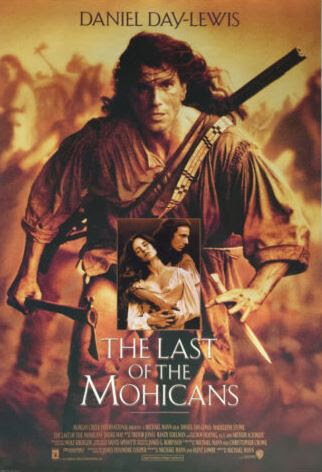
THE LAST OF THE MOHICANS (1992, Michael Mann)


The Last of the Mohicans

* * * 

In 1757, a white man brought up by the Mohican Native American tribe tracks down a British colonel’s kidnapped daughters.

Starring  Daniel Day-Lewis, Madeleine Stowe, Wes Studi, Pete Postlethwaite, Jared Harris

Written by  Michael Mann, Christopher Crowe

Produced by  Michael Mann, Hunt Lowry

Duration  112 minutes


Authenticity. That’s the most important thing in art, right?

Some people seem to think so. "Hey, did you know, it’s based on a true story?" "It is? Oh wow, drop everything and fire that baby up!"

The idea that something you are about to watch or read really happened is definitely fetishised in some quarters. The audience's desire for 'truth' was memorably played upon by the Coen brothers in FARGO, where they claimed that the events in the movie had really happened, when in fact they had not. Although the subsequent TV version did flog the joke to death somewhat by reiterating it at the start of every episode.

It’s like those people who won’t read novels. You know the type: they smugly inform you that they only read ‘for information’. Their time is much too precious to be wasted on childish made-up stories that interrupt their noble quest for knowledge.

I’m reminded of this exchange early on in SIDEWAYS between Paul Giamatti's wannabe novelist and his friend's future father-in-law.


Father-in-law: "What is the subject of your book? Non-fiction?"

Giamatti: "Uh, no. It's a novel, fiction. Although there is quite a bit from my own life ... so I suppose that technically some of it is non-fiction."

Father-in-law: "Good, I like non-fiction. There is so much to know about this world. I think you read something somebody just invented: waste of time."

Giamatti: "That's an … interesting perspective."


What has all this got to do what THE LAST OF THE MOHICANS? Its director Michael Mann, that’s what. Now, there’s a man(n) who loves him some authenticity and is not afraid to put in the necessary preparation.

Daniel Day-Lewis in The Last of the Mohicans


"Gosh, Mike, how d'ya make sure people get that sweet, sweet authenticity from your flicks?"

"I’ll tell ya how, buddy. I’m gonna stay overnight at Folsom Prison for THE JERICHO MILE. I’m gonna bring in the SAS fella who wrote Bravo Two Zero to give combat training so Bob De Niro and Val Kilmer look shit-hot in HEAT. For my MIAMI VICE movie, I’m gonna send Colin Farrell along on FBI drug busts in Dominican gang slums.

"And for MOHICANS, the granddaddy of them all? Well sir, this time I’ve got your man Double-D Lewis on board and let me tell ya, that cat’s as bonkers about prep as yours truly. So I’m gonna have him live out in the actual woods: tracking and skinning animals, building canoes, fighting people with tomahawks, and running about while reloading one of those old flintlock guns. And he’s gonna stay in character day and night, with that gun never leaving his Goddamn side."

Yes, finally the ultimate meticulous director met the quintessential method actor. So here’s the crucial question: did all that preparation and authenticity help towards making a great movie?

Well … I guess. It’s all kind of wasted on me, because MOHICANS just isn’t really my cup of tea.

Historical battle-type stuff doesn't do it for me. BRAVEHEART, GLADIATOR, 300, GLORY... I'm OK from about World War One onwards, but if you turn the clock back too far, all the elaborate costumes and wigs and "Yes my Lord, privy permit me to allow thy liege" stuff grates on me. Blokes swinging swords about on horseback doesn't raise my pulse; I sat through the LORD OF THE RINGS films one time only and have never seen an episode of Game of Thrones.


Russell Means, Daniel Day-Lewis and Madeleine Stowe in The Last of the Mohicans


MOHICANS is clearly a four-star film. It's tense, dramatic and competently acted by a talented cast. Mann's trusty cinematographer Dante Spinotti makes you feel the glow of the candles and smell the leaves on the trees. Trevor Jones's score is one for the ages, although he clearly recycled it a year later for CLIFFHANGER (now that's my kind of movie). The battles are well-staged and make you feel like you're really there.

But because I can't shake my two-star attitude, I'm going to have to meet this film in the middle. Sorry, Michael and Daniel – all the preparation in the world can't move someone who would rather be watching Stallone inauthentically climb up a mountain in a T-shirt.

Three stars out of five.


Valid use of the word ‘last’?  Since there was no sequel, nor one on the horizon, let’s just go for ‘yes’. 

What would a movie called THE FIRST OF THE MOHICANS be about?
 According to Britannica, "When first contacted by the Dutch, the Mohican were at war with the Mohawk, and in 1664 they were forced to move from Schodack, near Albany, to what is now Stockbridge, Mass." There ya go – there’s your plot. You’re welcome.


Previously:  THE LAST STAND

Next time:
  THE LAST HURRAH


Check out my books:  Jonathanlastauthor.com